Monday, October 15, 2007

Life and Death – Fatoumata and Sida

*Note: Despite being really excited about Hallmark and bogolan, I couldn't wait to post this. Continue below for bogolan information.

About a month ago, I got a phone call from someone in Douentza telling me that my host Mom had given birth. I was so excited but I was so busy with Hallmark that I couldn’t go for the baptism and to visit. I sent some money but I was really excited when Peace Corps was headed out to Douentza to visit the new volunteers because I hopped a ride with them. On Wednesday, October 3, I headed out to Douentza with gifts in hand. I got to see my new baby sister, who incidentally was named after me, and she is gorgeous!


Baby Fatoumata.


It was hot, she was tired.


Precious, tiny, little feet!


I saw Umu and the rest of the gang, and I got some good home cookin’ and it was a great day. I came back to Sevaré the same day, despite Umu wanting me to stay the night. I plan on going back to visit and see everyone, but with being in the middle of projects I just can’t right now.

Then Monday, October 8, I got a phone call from the volunteer who replaced me in Douentza. He lives at my house and with Umu and called with really bad news. He said he didn’t know what happened but that my host sister died. I immediately thought it was Fatoumata because it’s so easy for babies here to die. But he told me it was Sida, the 5 year old, not Fatoumata. I was devastated. I love that little girl. She’s so beautiful and full of life and had such an energy about her that I couldn’t believe it. I talked to Umu and she was just so matter of fact, “Fatumata, Sida is dead.” There wasn’t any sadness in her voice, nor did it sound like she had been crying or that it had even taken a toll on her. Life and death here are just so different. We think that Sida had malaria, but all Umu said was that she had a fever in the morning and died by the afternoon. So, with one new life, someone has to die also. It’s tough when those people are close to you.

So, in an effort to honor Sida and show her off to everyone, here are some photos I’ve taken of her.

Sida washing dishes.

Being hesitant of the camera.


Her and that sassy attitude. Has 'model' written all over it, doesn't it?


After crying, trying to calm down inside of her house.


Mango eating. Food pictures are the best!


Standing with her brothers, Hassin and Hama.


The last day that I saw her, she wasn't sad or sick - despite how she looks - and we had a great time.

I'll miss you, Sida.

Monday, October 08, 2007

The Unveiling of my Project!


Finally, the unveiling of my life for the past few months! Before I even get into details, I’ve become really emotional about this project because it has such amazing implications in Mali and throughout Africa. I’m really proud to have been part of it and I’m really happy to share it with all of you. So, drum roll please…I’ve been working with Hallmark Greeting Cards and Bono’s Product Red to help Malians produce a handbag made of local materials for sale in Hallmark stores. Bags hit stores TODAY!

Below you’ll find The Story of Bogolan Bags in Mali and The Economic Impact on Mali. Read them both and check out the photos because it’s all very exciting. It’s been my life – inside and out – since I moved here in May and it’s been stressful but amazing. First of all, for Hallmark to even come to Mali – third least developed country in the world – is a huge step. Hallmark representatives came three times, once with an English NGO called AfricaNow who conducted a labor assessment to ensure fair labor standards and another time with an amazing videographer named Nicole who shot bogolan for a week in order for Hallmark to put a video together about that (website forthcoming). Hallmark has been nothing but a pleasure to work with, but the stress came in trying to act as the intermediary between Hallmark and Malian producers. For me, it was a crash course in Business Management and honestly, I’m probably more than half way to getting my MBA. I sacrificed having the “normal” Peace Corps experience of sitting around in village and reading or traveling around to visit friends. My friends never saw me, but always knew where I was.

One of the most exciting parts about this all is that my friends and family (and American consumers) get to see the fruits of my – and my Malian counterpart’s – labor. It’s so rare for a Peace Corps project to hit American soil and for our friends and family to really understand what we’re working on. My project is tangible for each and every one of you. Though you’d never be able to understand the process and every drop of sweat that went in to it, I’m doing my best to paint you a picture and I hope that you can appreciate it all.

Now, I’m not asking you all to rush to your closest Hallmark store to buy a bag. But, it is Columbus Day and most of you have the day off and it would mean so much to me and to my team here at Farafina Tigne if you at least checked them out. They aren’t going to every single Hallmark store, but there are close to 3,500 stores, so there’s a good chance it’ll go to yours! There are a limited number of bags for these 3,500 stores, but I do know that they're supposed to be around until March - in theory. I know a lot of you are in DC, and they’re only at the store at L’Enfant Plaza, but they’re also in Bethesda, Arlington, Alexandria and around. Go, right now! Here are the two designs that we made at Farafina Tigne:


I would love to hear from you about what you think. Anyone who wants to take photos, I would welcome that with open arms too. I’ve worked on the production side of it and I would love to see the publicity and marketing. Speaking of that, the bags will be on the Rachel Ray Show Friday, October 12. So, tune in, tape it, do whatever you have to, but watch it! They may also be promoted on The Today Show and Good Morning America and the video that Nicole took of bogolan here may be used. This means that my interview could be on TV (though, let’s not hold our breaths). Trust me, you’ll be the first to know when and where to tune in to check it out.

So, like I said, GO TO HALLMARK RIGHT NOW and check the bags out. I can’t wait to hear from you all!

Hallmark’s Economic Impact on Mali

We worked closely with the West African Trade Hub, a USAID organization based in Accra, Ghana. They compiled the following Fact Sheet regarding this bogolan project:

Fact Sheet Hallmark Order in Mali
Companies: Mali Chic of Bamako and Farafina Tigne of Sevare

Total Order: (information omitted)
Total Value: (information omitted)
221 workers in Bamako, San, Sevare and Mopti
Average monthly earning for tailors working on the order: 103,283 CFA ($219)
Average monthly earning for bogolan dyers working on the order: 69, 497 CFA ($147)
Minimum monthly wage in Mali: 28,000 CFA ($63).
210,000 meters of bogolan (made in Mali from 100% Malian cotton)
White interfacing also made an purchased in Mali
Imported materials: needles, thread, lining and labels
Duty Free under the United States African Growth and Opportunities Act (AGOA). First textile product exported under AGOA in Mali.
Upcoming orders: 128,000 beaded strands for greeting cards.
Technical Support: USAID, US Peace Corps, MBA’s Without Borders, Africa Now.

Those are the hard facts and hard numbers, but what about how people are actually feeling? Despite it being very tiring and there being a lot of forces to overcome – rainy season, the holy month of Ramadan – all of the people working on this order were extremely pleased. It gave everyone the opportunity to have more money than they otherwise could have. An average tailor probably wouldn’t have earned even half of what they did without the order. People were able to better provide for their families, buy new sewing machines for their own shops and even one tailor saved up to buy land for a new home for his family. This order meant different things for different people, but in the end it offered everyone additional income, and as an effect of that additional happiness and less stress at home.

From a development standpoint, things didn’t always go smoothly. They were hard, every day. But in the end, now that I can see these bags and see all of this hard work in stores for the American consumer to buy, I’m so happy. A mostly locally made bag, contributing to the overall development of the Malian economy, plus the added benefit of the Product Red label giving money back to Africa. What more could we have asked for?

The other great thing is that new orders are coming in already for both Mali Chic (our partner company in Bamako who we split the bogolan order with) and Farafina Tigne. The Hallmark endeavor will hopefully be just the beginning of a successful economic development scheme here in Mali.

The Story of Bogolan Bags in Mali

Here are the details, with lots of photos! Two weeks after I site changed and moved to Sevaré, Hallmark engaged in a project with a local artisan here named Peace Corps Baba. He’s named as such because he has a long history with PCVs and just an overall amazing person. He owns a shop called Farafina Tigne, or African Reality. He’s a character and one of the most amazing people I’ve ever met. His normal business is mainly in traditional jewelry and he creates his own necklaces to sell around the world. He also specializes in beads and has a small bead museum in his shop, displaying antique beads from all over Africa, and beyond. Here is his shop:


The front of Farafina Tigne.

An example of the amazing beads that Baba has in his museum.


Shameless plug, but check out http://www.farafinatigne.com/ to see what he does. He had a successful business and did some work with bogolan – or mud cloth - which is a cloth here that we dye using mud and is used for all sorts of purposes (to reintroduce you to my blog on the making of bogolan, check out A Day in the Life of Bogolan from June). Hallmark decided that they wanted to make some handbags for their stores. We met with tailors and chose a core team to work with for our additional order bags. We set up schedules and workshops and an assembly line – things that had never been done here before. We taught tailors the importance of using a tape measure to get accurate measurements, instead of just eyeing it, which is what they commonly do here.

We went through every stage of production and quality control and shipping. Production started around June 18th, and we’ve been producing almost every day and shipping every week since then. Production starts with measuring and cutting the bogolan into preset dimensions. We made models that could be traced in order to make sure each piece was exactly the same. After all of the pieces are cut, they’re brought down to the workshop, or in French atelier, and the assembly line begins. Here are some photos of the production:
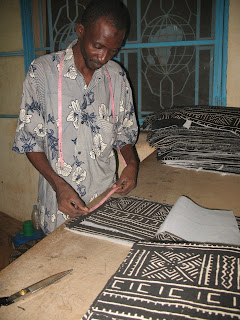
Measuring and cutting the body of the bags.


Hundreds of bodies and bottoms cut out, ready to head down to the workshop to be sewn.


Day 1 of production. People were fresh eyed and the workshop was still clean!


Attaching the popline, or black lining, to the bottom of the bag.


We set up an additional workshop in Mopti and didn't put motors on the machines. He was making the bags with his feet (foot pedal), literally.


The day that Hallmark came to shoot, everyone got dressed up in traditional clothes.


A bag in progress. He sewed the Hallmark labels on the inside of the bags.


Hard at work lining the bodies of the bags.


It's always nice to see a huge pile of bags done and waiting to be controlled!


Cutting the handles for the bags and attaching them.
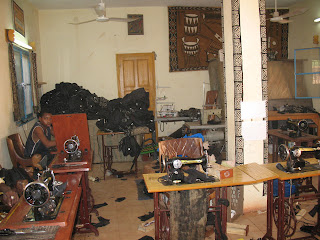

This is how the workshop normally looked - cluttered and messy with random bags and pieces of bogolan around.


At the end of every shift, bags are piled – and I do mean piled – into a storeroom to await finishing touches such as labels and then they’re sent off to Quality Control.

Hundreds of bags piled awaiting finishing touches and to be controlled.


Quality Control was probably one of the most frustrating parts of this project. Things here aren’t QC’ed. Tailors will make your clothes and give them to you and if there’s a problem you can bring them back. They don’t cut off loose threads, they don’t verify measurements – they just don’t! So, the education aspect of all of this, trying to teach people that we needed 20,000 identical handmade bags was hard even for me to imagine. In the end, in all worked out and we were able to successfully QC most of our bags.

Our Quality Control team working on verifying measurements, cutting off excess strings and making sure the bags were ready for shipment to the States.


Quality Controlling continues.


At the end of every day, we count the bags into stacks of 20 for packaging. The RED labels amongst the sea of black and white is pretty awesome.


The bags are then bundled up into big fabric or plastic sacs to send down to Bamako.


There was even one night we took all of our finished bags to Peace Corps Baba’s house in Mopti and I worked with his wife and some other women until 2:30 AM to control them. Most Malians don’t work like this, but Baba is almost American, so I can’t expect anything different!

Peace Corps Baba's wife and family friends working late into the night controlling bags.


After we QC everything, we pack it up. We have to ship everything down on public transport, so it’s important that the packages aren’t too big. We normally put between 300-500 in each package and take them to our friends at Bani Transport to haul all the way down to Bamako.

Our good friends at Bani Transport were always really excited to see us every week and try to get more money out of us for shipping these packages. On average, we paid $4-$6 per package to go to Bamako.


Once in Bamako we do another QC check, but also sort and count everything and add a silica gel pack (to absorb any moisture). Our team in Bamako packages all of the bags in cardboard boxes and we haul it all off to fumigation. Of course, during the process of QC –both in Sevaré and in Bamako we find bags that have problems. Maybe it’s a hole where the sewing machine didn’t catch the fabric, a missing label or a measurement gone terribly wrong. Either way, we have to deal with all of these things and it takes time.

The team in Bamako. Here they do one final QC check and add silica gel packs to each bag.


It's tiring, especially during Ramadan, so breaks are often taken. The bags provide a comfortable resting place, not just a trendy handbag!


After all of the silica gels have been added, packaging for fumigation begins. We put 150 bags in each box.


Good thing we did that 2nd QC check - these are all of the bags that we found fault with.


Just an example of the fault - this piece of bogolan for the body was not well cut.


After a day or more in fumigation, all of the boxes head to the airport to fly out, via DHL. I haven’t spent enough time on the Bamako side to photograph the latter two things, but you get the idea.

So, there you have it. The birth of a bogolan bag produced especially for Hallmark’s Product Red line. Oh, I didn’t mention that, did I? Yeah, these bags are a part of Bono’s Product Red line in which a certain percentage of profits goes to the Global Fund to help fight AIDS in Africa. Talk about the perfect project – bogolan bags produced in Mali with local goods and the profits from sales come back to help them.

Hallmark RED label on the inside of each bag. It reads: "This authenic mudcloth bag was made by artistans in the Republic of Mali in West Africa using traditional Bambara patterns. Natural earth dyes are used to make this 'bogolan' - or mudcloth - bag. Dyes may rub off on light colors. Hallmark is a proud partner of (Product)RED.


Here are the (RED) labels on the outside of each bag.

Tuesday, October 02, 2007

Dakar, Senegal

Instead of taking a vacation to Senegal, I decided to get sick and be Medivac’d there. Joking…kind of. I had to take a trip to Senegal to have an MRI done because there is no MRI machine in Mali. Crazy, huh? It was nice to get away from Mali for a few days and enjoy the sites and scenes of Dakar. Of course, there is the unmentionable amount of money that I spent. Oh well, who knows if I’ll get back there again, right? And I got some amazing items that will last a lifetime.

Here are some photos from my journey there, and back:

Me, on the Île de Gorée, overlooking the colorful houses and the ocean.

The Dakar Skyline.


Leaving the port of Dakar to head to Île de Gorée.

Arrival at the Île de Gorée. It's so colorful and I wasn't used to that. It gave me a real good feeling to be there.

Like most places on the coast of West Africa, the Île de Gorée has slave history. This moment was given to Senegal from the island of Guadeloupe in rememberance of the terrible history of the slave trade.

At the Maison des Esclaves (House of Slaves) there were a lot of quotes left by famous/important people and they were pretty heartfelt.

Me, on the ferry heading back to Dakar. Île de Gorée is so beautiful!

A random photo of the villa-esque streets of Île de Gorée. I could probably live there.

Coming up next, I attended a basketball game between the women's national teams of Senegal and Mali while I was in Senegal. Can't wait to show you the footage.

Oh, and Ramadan is going amazingly, but more on that later too!

Friday, September 28, 2007

An African Phenomenon

Funny story posted by Yahoo! News regarding cell phones and Africa. It's not just an African phenomenon, because it happened when I was in Europe too. Basically, anywhere that there is prepaid cell phone service, people will want to save their money and just beep the other person forcing them to call you back. It's great.

Enjoy!

Phone credit low? Africans go for "beeping"

KHARTOUM (Reuters) - If you are in Sudan it is a 'missed call'. In Ethiopia it is a 'miskin' or a 'pitiful' call. In other parts of Africa it is a case of 'flashing', 'beeping' or in French-speaking areas 'bipage'. Wherever you are, it is one of the fastest-growing phenomena in the continent's booming mobile telephone markets -- and it's a headache for mobile operators who are trying to figure out how to make some money out of it. You beep someone when you call them up on their mobile phone -- setting its display screen briefly flashing -- then hang up half a second later, before they have had a chance to answer. Your friend -- you hope -- sees your name and number on their list of 'Missed Calls' and calls you back at his or her expense. It is a tactic born out of ingenuity and necessity, say analysts who have tracked an explosion in miskin calls by cash-strapped cellphone users from Cape Town to Cairo. "Its roots are as a strategy to save money," said Jonathan Donner, an India-based researcher for Microsoft who is due to publish a paper on "The Rules of Beeping" in the high-brow online Journal of Computer Mediated Communication in October. Donner first came across beeping in Rwanda, then tracked it across the continent and beyond, to south and southeast Asia. Studies quoted in his paper estimate between 20 to more than 30 percent of the calls made in Africa are just split-second flashes -- empty appeals across the cellular network. The beeping boom is being driven by a sharp rise in mobile phone use across the continent. Africa had an estimated 192.5 million mobile phone users in 2006, up from just 25.3 million in 2001, according to figures from the U.N.'s International Telecommunication Union. Customers may have enough money for the one-off purchase of a handset, but very little ready cash to spend on phone cards for the prepaid accounts that dominate the market. Africa's mobile phone companies say the practice has become so widespread they have had to step in to prevent their circuits being swamped by second-long calls. "We have about 355 million calls across the whole network every day," said Faisal Ijaz Khan, chief marketing officer for the Sudanese arm of Kuwaiti mobile phone operator Zain (formerly MTC). "And then there are another 130 million missed calls every day. There are a lot of missed calls in Africa."

'CALL ME BACK'

Zain is responding to the demand by drawing up plans for a "Call-me-back" service in Sudan, letting customers send open requests in the form of a very basic signal to friends for a phone call. The main advantage for the company is that the requests will be diverted from the main network and pushed through using a much cheaper technology (USSD or Unstructured Supplementary Service Data). A handful of similar schemes are springing up across Africa, says Informa principal analyst Devine Kofiloto. "It is widespread. It is a concern for operators in African countries, whose networks become congested depending on the time of day with calls they cannot bill for. "They try to discourage the practice by introducing services where customers can send a limited number of 'call-back' request either free of charge or for a minimum fee." There are plenty of other reasons why mobile operators are keen to cut down on the practice. One is it annoys customers, pestered by repeated missed calls. A second is that 'flashes' eat into one of mobile phone companies' favorite performance indicators -- ARPU or average revenue per user. Miscalls earn very little in themselves - and don't always persuade the target to ring back. Orange Senegal, Kofiloto said, lets customers send a 'Rappelle moi' ('Call me back') when their phone credit drops below $0.10. With Safaricom Kenya, it is a "Flashback 130" (limited to five a day -- and with the admonishment 'Stop Flashing! Ask Nicely'). Vodacom DR Congo's 'Rappelez moi SVP' service costs $0.01 a message.

MORE THAN MONEY

But beeping is not only about money. Donner's 'Rules of Beeping' suggests a social protocol for the practice. "The richer guy pays," he writes. It is acceptable to beep someone if you are short of cash and they are flush with credit. Never beep someone poorer than you.
Never beep someone you are tapping for a favor. You don't want to risk annoying the person you are trying to win over. Never flash your girlfriend, unless you want to look cheap.
"Most beeps are requests to the mobile owner to call back immediately, but can also send a pre-negotiated instrumental message such as pick me up now,' or send a relational sign, such as I'm thinking of you,'" the paper says. It can go even further than that. Cameroonian researchers Victor W.A. Mbarika and Irene Mbarika identified a different kind of beeping-powered relational call in a study for the technology association the Institute of Electrical and Electronics Engineers (IEEE). "Lovers often communicate with text messages or beeping'," said the study. "One party dials another's number and then hangs up. One ring could mean, I am here,' two rings, Call me now.'" And the name they gave this new entry in the beeping lexicon? Borrowing a street slang term for an appeal for sex, they christened it "the booty call."

Wednesday, September 12, 2007

September 13, 2007 - Ramadan Begins

Tomorrow is the beginning of the Muslim holy month of Ramadan. I’ve Wikipedia searched a short exerpt for your reading pleasure:

“The third pillar of Islam, which is fasting, is practiced during the month of Ramadan. Ramadan is derived from an Arabic word for intense heat and scorched ground. (in Arabic: رمضان, Ramaḍān) – – and it is the ninth month of the Islamic (Hijri) calendar, established in the year 638 CE. It is considered the most venerated, blessed and spiritually-beneficial month of the Islamic year. Prayers, fasting, charity, and self-accountability are especially stressed at this time; religious observances associated with Ramadan are kept throughout the month.

"Ramadan is the month during which the Quran was revealed, providing guidance for the people, clear teachings, and the statute book. Those of you who witness this month shall fast therein. Those who are ill or traveling may substitute the same number of other days. Allah wishes for you convenience, not hardship, that you may fulfill your obligations, and to glorify Allah for guiding you, and to express your appreciation."[2:185]”

Last year Ramadan started shortly after I arrived. With trying to assimilate into Mali, I didn’t give fasting a second chance. I was already losing enough weight due to sickness. So, I’ve survived a whole year here and I’ve decided that I want to step up my acceptance/assimilation process and observing Ramadan is a good way to try that.

Now, here are some differences between a Malian fast and the Sara Rosen fast. Malians will wake up at 4 AM-ish (before sunrise), pray, eat and go back to sleep until they have to start their days. They will continue throughout the day to ingest nothing – this includes saliva. At 6 PM-ish (at sunset/prayer call), iced cold drinks, tea and fried foods will all be ready for the break fast. Malians will drink and eat a little, saving most of their appetite for dinner. Repeat steps 1 through 5 for 30 days.

The Sara Rosen fast will consist of the following. I will wake up around 5:30 everyday to eat breakfast, going back to sleep until at least 8 (I hope!). I will continue throughout the entire day without eating, but I will be drinking water. My abstention from drinking will include juices, sodas and alcohol. Frankly, if I didn’t drink water for one hot Malian day, I would not be well. At the break fast, I will let Malian’s enjoy their cold drinks and fried foods, and I will enjoy whatever fruit is seasonally available. Dinner will definitely be something for me to look forward to every night (recipes during this month are warmly accepted and greatly appreciated!).

As the most spiritually beneficial month of the year, I’m really going to take this opportunity to become more introspective and spiritual. Whether that means taking 10 minutes a day to meditate and reflect on my day or to actually start practicing Yoga, I don’t know yet. But, I need to figure it out, soon!

It’s going to be a tough month, but I think it will be really beneficial to my overall psyche. Updates along the way are certain and a personal thoughts post at the end of the month (after the fete!) is certain also.

Wish me luck!

P.S. I’ve also started a small experiment. It’s obvious that there will be some connection between not eating and losing some inches. So, I’ve already taken my measurements and will continue to do so each week throughout the month to see what the correlation is. Results forthcoming!